Δευτέρα 18 Ιουνίου 2012

Lindner Group - Lunar


Lindner Group raises ceiling design to a higher level thanks to its new surface line Lindner Lunar. As an alternative to common ceilings with plain surface structures, Lindner follows the trend towards three-dimensional structures merged with high-gloss surfaces.


The combination of manifold stamping and punching sizes and shapes creates vivid effects and a trendsetting design. These high-gloss surfaces get their three-dimensional look by means of, for example, matted areas or special scattered perforations.


Impressive images in the brochure “Uniquely vivid – Lindner Lunar” provide an overview of the new possibilities of a creative ceiling surface design. Recently, the Lindner Group installed a metal ceiling made of hammered, highly polished stainless steel in the Tsvetnoy Central Market, Moscow. The shopping centre received the “EuroShop RetailDesign Award 2012” and “Best Interior Design Award 2011” and is now officially rated as one of the best shopping centres worldwide.


Lindner Lunar ceiling panels impress both with their high quality and great flexibility as well as with their exceptional variability in terms of design. Ceiling panels equipped with sophisticated lighting solutions made by Lindner perfectly complete the ceiling package.

Κυριακή 10 Ιουνίου 2012

Private White House, Tinos, Greece


This private white house located in Tinos, Greece was designed by Zege architects paying every amount of respect to the surrounding architecture of the area. This stunning white space is the vacation home of its brilliant interior designer, Marilyn Katsaris.


The soft edges and brilliant natural tones create a sense of serenity as you pass easily from one area of this white home to the next. The carefreeattitude that white living represents is boldly declared by the lack of hiding places. Minimalistic niches are built into the wall to stow away objects, and beautiful thick shelves hold dishes and ornaments. 


This contemporary interior differs from the traditionally modern view of white design. Instead of hard edges and fluorescent brilliance, this home makes the best of soft textures and serene naturally diffused light. Classic comfort and a sense of history are created by rich, traditional ornamentation used only sparingly.

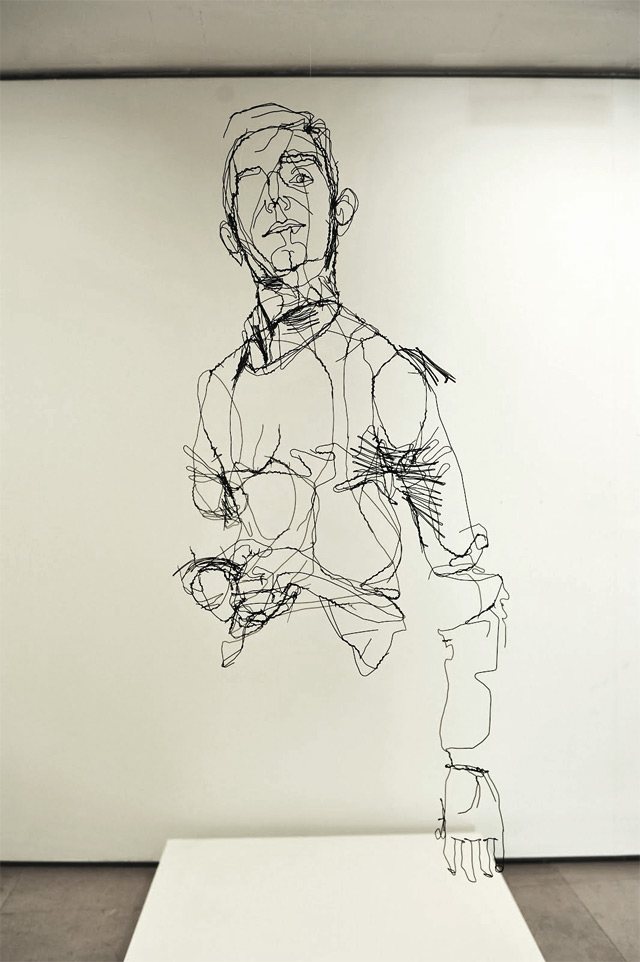
Wire Sculptures

Lisbon-born sculptor David Oliveira creates delicate figurative sculptures using wire that’s formed to look like manically drawn ink sketches on top of photographs. Some pieces are even hung by invisible filament creating the illusion of hovering in place. See much more of his work on his website and Facebook. If you like these also check out the work of Gavin Worth. (via my modern met)


Παρασκευή 1 Ιουνίου 2012

The Taste Of Fashion by Fulvio Bonavia


Great creation through successful inspiration is a quality that few people possess. Fulvio Bonavia has both.  An award-winning advertising and editorial photographer, Fulvio Bonavia is a true talent who has fulfilled the highest demands of the hungry eye. His work has been honored by Communication Arts, PDN, the Italian Art Directors Club, and the IPA, among others, and Luerzer’s Archive has named Fulvio one of the ‘200 Best Ad Photographers Worldwide’. With the publication of his book ‘A Matter of Taste’ he has achieved the unity of two conflicting worlds throughout time; Food & High Fashion. Both adored and wanted but at the same time forbidden.


A Matter of Taste’ illustrates high end fashion garments and accessories from the world’s most famous designers made from food. The beauty though does not stop there. Through the use of great  lighting, illustration, transparency and retouching, these pieces have an untouchable style of their own that project a priceless quality only seen before in exceptional pieces from a museum. Louis Kahn had once said ‘Even a brick wants to be something’. In this case its broccoli, prosciutto, artichoke leaves, a watermelon or even granberies. These are all sources that we take for granted daily and it took a true artist to make us stop and admire what we call the simple things in life. And boy, do we love the customization of these daily 'jewels'.


Πέμπτη 31 Μαΐου 2012

Trattoria Capanna, Athens


A unique Italian atmosphere is emerging in the restaurant «Trattoria Capanna», at the corner of Grace and Plutarch in Kolonaki.
The Greek team of decorators K Studio, have used materials and colours that achieve an unpretentious elegance in adistinctive, warm environment that refers to a typical "Italian courtyard."


 Old shutters have been used as parts of the walls of the Italian restaurant, combined with the murals of artist Joanna Burtenshaw, as well as concrete tiles, travertine rock to form the "canvas" on which they have added touches such as vintage chairs and tables, to perform successfully the concept of Mediterranean courtyard.


Πέμπτη 24 Μαΐου 2012

Cave House, Milan

More than a place to live in, this is a workshop of visionary creativity. Tiziana Serretta who began her professional life as a judicial university researcher and professor, abandoned academia and devoted herself to the arts and has given life to an unexpected house in Milan.  From collector to dealer, she opened an art gallery specifically devoted to everything ancient, and in more detail, to sculptured jewelry in her home town in 1990 in Palermo, Sicily.  Now as Diana Vreeland Ltd, a name that has been of great inspiration for Mrs. Serretta, her activity is based in London and participates in major Art international exhibitions.

Mrs. Serretta has to her credit, various publications and co-operations with worldwide museums and the rediscovery of crucial figures such as Sterlè, Marchak  and Andrew Grima as well as her vintage haute couture collection from names such as Vionnet, Dior, Sciapparelli, YSL, Cardin, Rabanne, Valentino, Capucci, Courrèges, Pucci, Givenchy and Balmain. Her new escapade ArTS is in the groove of interior design and the research of unexplored concepts and new extraordinary materials.
ArTS’ first achievement is this Milanese home comprising artists and craftsmen, such as Eugenio Catemario di Quadri,Massimo GiudiciRuggero ProjettiAntonio FalsaperlaClaudio FogliaGianni Mattiacci and Ennio Cacciamani. As Serretta herself says, her concept of the home is based on the principle of mobility and weightlessness, a structure that is easily moved with very low masonry costs where the designed volume can be easily dismantled and shipped away.

This 230 square metre apartment has been transformed into a dreamy, oneiric, ancestral, mysterious organic grotto of the future, swinging from monolithic walls, from free circulation of energetic continuous movement, where the log cabin edged restrooms are the only closed space of the apartment, alongside the circular strange baptistery corian bathtubs. The furniture and the custom made walls are realized in a mixture of chalk covered in resin, cement powder, chromatic pigments and non-hazardous plastics. The kitchen is made out of practical steel and fully equipped, state of the art. The ceiling has been brought back to the original cement, obliterating every single added layer. The pavement that integrates the full spacial expansion is made of pale resin mixed personally by Mrs. Serretta to volcanic sand, gold dust and mother of pearl powder. 

(yatzer.com)

Τετάρτη 16 Μαΐου 2012

Manhattan Subway

This post is all about the historical  past of the construction of New York's   subway.
Manhattan 's subway is one of the oldest and the largest .The length of the subway is currently estimated at around  1355km.
Although the oldest subway is located in London, New York's is equally important due to the fact that it was built with no high tech technology but with only labour and horses.
Initially the subway had only 24 stations.Nowadays New York's metro has  460 stations and  it servs over 1.64 billion people annually. 
The following photos are the best way to illustrate how the metro was build and also  to illustrate the pain staking process of builting it.


 The photos were publiced by the Municipal Archives  of New York and show the work that has been done between the period of 1901 and 1931. The first stations were opened at 1904.